Engagement You Can Measure on the Floor: Turning a Survey Score Into Safety and Compliance Numbers

Gallup's 11th-edition Q12 meta-analysis compared the top and bottom quartiles of engagement across 183,806 business units and found a 78% gap in absenteeism.12 The same study reported a large difference in safety incidents between the most and least engaged teams.3 These are not attitudes captured on a spring survey. They are attendance logs and OSHA 300 entries, the same numbers a plant manager reviews every month.

The disengagement-to-incident link is documented, and it is large
The meta-analysis is the anchor here. It accumulated 736 research studies across 347 organizations in 53 industries, covering employees in 90 countries and 183,806 business and work units that included 3,354,784 employees. Among the 11 outcomes it measured were safety incidents, absenteeism, turnover, and quality defects. The direction is consistent: higher engagement, fewer incidents and absences.
The scale of the engagement deficit is worth stating plainly. Gallup's 2024 data found 62% of employees not engaged and 15% actively disengaged, with only 23% truly engaged in their work. Those low levels cost the global economy approximately US$8.9 trillion, about 9% of global GDP.
One caveat belongs here. Gallup's analysis measures correlation at the business-unit level, not a controlled causal experiment, and much of the vendor commentary that repeats these figures rounds or reframes them. When you cite the numbers to leadership, cite the meta-analysis itself, not the secondary summaries.

The cost side is concrete
Engagement's payoff shows up against a real injury bill. Private industry employers reported 2.5 million nonfatal workplace injuries and illnesses in 2024, the lowest for the series going back to 2003. The incidence rate of total recordable cases in private industry was 2.3 cases per 100 full-time equivalent workers, down from 2.4 in 2023 and also the lowest on record.
Rates are falling, but the direct cost stays high. Liberty Mutual's 2025 Workplace Safety Index found that employers pay more than $1 billion per week in direct workers' compensation costs for disabling, nonfatal injuries alone. A single incident avoided is a real number a CFO recognizes.
Manager quality sits underneath much of this. Gallup found that the quality of management explains 70% of the variance in team engagement. Its 2025 research showed manager engagement fell from 30% to 27% globally, dragging down entire teams and driving absenteeism. If your engagement problem is really a manager problem, no amount of signage fixes it. Say that to leadership before you propose a graphics budget.

Mobile-first communication moves compliance numbers
The 2025-2026 evidence points to a specific mechanism: getting safety information to non-desk workers in a channel they actually use. The reach problem is severe. Only 10% of non-desk workers are satisfied with the internal communication they get, which leaves 90% of the front line as a missed opportunity. And the gap has a safety cost. Firstup research shows that up to 12% of hourly workers say poor communication has put their safety at risk.
Channel fit explains why the mobile-first shift works. Legacy intranets average 30 to 40% adoption because they were built for desks and never reached the frontline, while platforms built for mobile-first frontline use see materially higher engagement because the channel matches how the work actually happens. Vendor case data in 2025 tracks the same pattern. PHX Ireland, which includes McCabes Pharmacy and United Drug, cut administrative tasks for its frontline team by 40% by digitizing daily operations, letting teams complete checklists and receive sensor alerts from mobile devices. Across a broader book of business, EcoOnline reported a 40% uplift in mobile app usage for safety workflows alongside 30% year-over-year growth in training and learning revenue in the UK.
Read these figures as adoption and usage gains, not as controlled reductions in injury rates. The mechanism is plausible and the compliance data is directional, but the peer-reviewed causal study tying a specific app to a specific drop in recordables is not yet in hand. The auditable advantage is more defensible. A centralized platform gives compliance a clear, timestamped record of what was published and when, which scattered group texts never can.
Where signage and visual standards earn their place
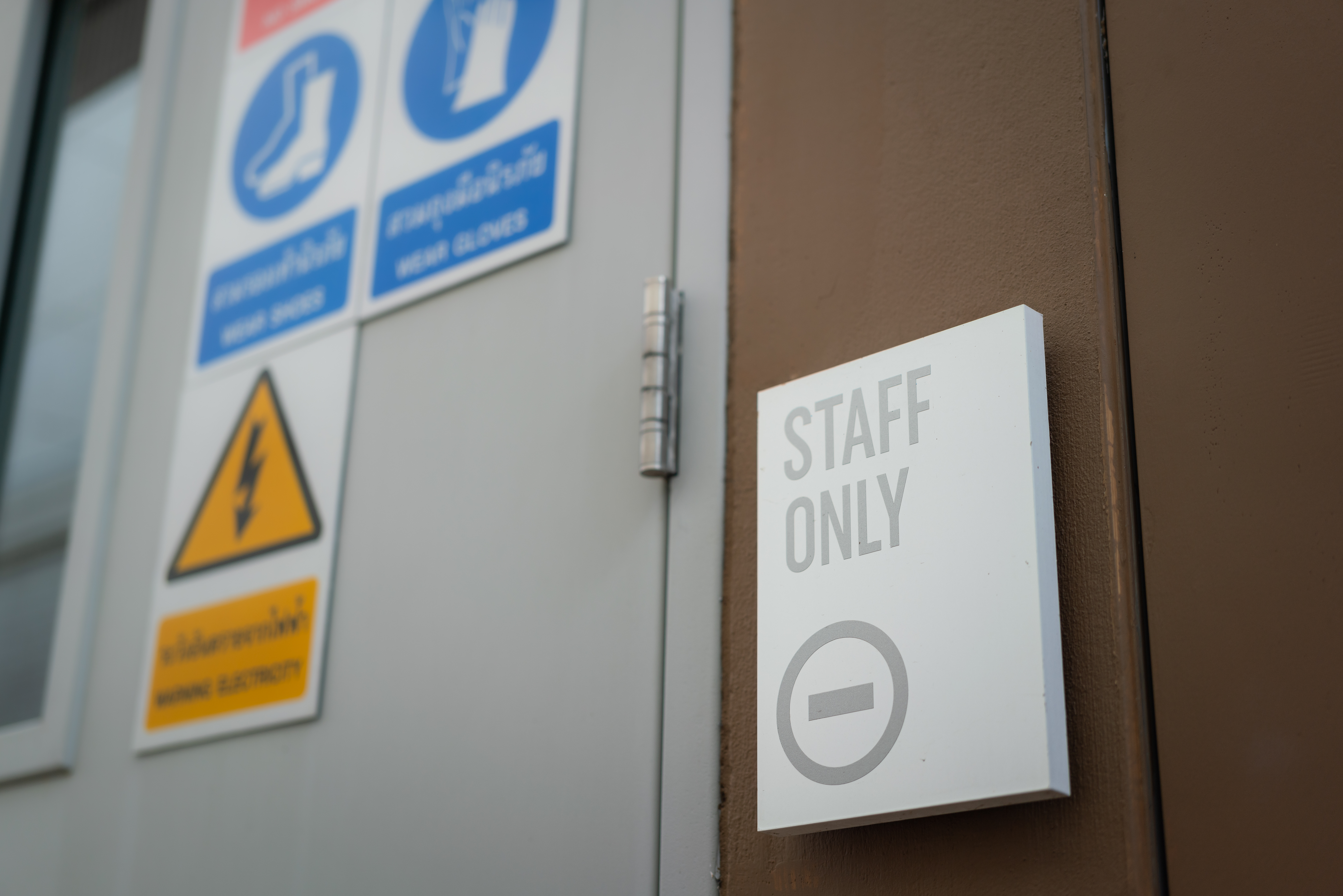
Digital reach handles the moving information. Fixed hazards still need physical, standardized marking, and that is governed by law. OSHA's general industry standard 29 CFR 1910.145 specifies requirements for accident prevention signs and tags: danger signs must use red as the primary color, black as secondary, and white for the message panel, with the word "DANGER" in the header. Those signs are reserved for areas where an immediate hazard presents a risk of death or serious injury, and OSHA requires them to be legible and understandable to all employees who may encounter them, which matters in multilingual workplaces.
ANSI Z535 is the design system OSHA leans on. ANSI Z535.1 lists exact safety red as Munsell 7.5R 4/14 and safety yellow as 5Y 8/12, and faded or off-spec signs can be cited as inadequate even when the wording is correct. The signal-word hierarchy is precise. Orange marks WARNING for a situation that could cause death or serious injury, yellow marks CAUTION for potential minor or moderate injury, and blue is the NOTICE color for operational information unrelated to injury risk.
There is a hard limit worth naming to any leader who thinks signage is a cheap substitute for engineering. OSHA treats signage as an administrative control near the bottom of the hierarchy of controls; a sign warning about a missing machine guard does not replace the guard, and inspectors will cite both the missing engineering control and the inadequate sign program. Signage supports a safety culture. It does not manufacture one.

Making the budget case in numbers leadership already reports
The argument to leadership writes itself once you use their metrics. Engaged units run measurably lower absenteeism and fewer incidents, both of which sit in reports the executive team already reviews.13 Reaching the floor on mobile lifts documented compliance completion and gives you a timestamped audit trail.76 Standardized ANSI Z535 signage keeps you off the citation list and holds up in liability review.911
Two honest limits keep the case credible. The engagement-to-outcome link is correlational, and the compliance gains reported for communication platforms come largely from vendors rather than independent trials. Present the meta-analysis and the BLS and Liberty Mutual figures as your load-bearing evidence, and treat the platform case studies as supporting, not proof.
References
- Gallup — Q12 Meta-Analysis: The Relationship Between Engagement at Work and Organizational Outcomes (11th Edition). https://www.gallup.com/workplace/321725/gallup-q12-meta-analysis-report.aspx
- WorkTime — 55 Employee Engagement Statistics for 2026 (Latest Data). https://www.worktime.com/blog/statistics/employee-engagement-statistics-latest-data
- Forbes (Kara Dennison) — Gallup Says $8.8 Trillion Is The True Cost Of Low Employee Engagement. https://www.forbes.com/sites/karadennison/2024/07/16/gallup-says-88-trillion-is-the-true-cost-of-low-employee-engagement/
- Talkspirit — Key Employee Engagement Data from Gallup's 2024 Study. https://www.talkspirit.com/en/blog/key-employee-engagement-data-from-gallups-2024-study
- U.S. Bureau of Labor Statistics — Employer-Reported Workplace Injuries and Illnesses, 2023–2024 (released January 22, 2026). https://www.bls.gov/news.release/archives/osh_01222026.pdf
- Firstup — Your Safety Program Works. But Is Your Safety Communication Strategy Keeping Up? https://firstup.io/blog/safety-communication-strategy/
- MangoApps — How to Improve Frontline Communication in 2026. https://www.mangoapps.com/articles/how-to-improve-frontline-communication-2026
- SME / Advanced Manufacturing — How Frontline Communication Drives Retention and Safety. https://www.advancedmanufacturing.org/leadership-innovation/viewpoints/how-frontline-communication-drives-retention-and-safety/article_c5279afa-b928-46d7-bc33-340222c2e45e.html
- SafetyCulture — SafetyCulture Next 2025 Recap. https://safetyculture.com/company-news/safetyculture-next-2025-recap
- BusinessWire / EcoOnline — 2026 Safety Trends and 2025 Momentum. https://www.businesswire.com/news/home/20260312632068/en
- OSHA — 29 CFR 1910.145, Specifications for Accident Prevention Signs and Tags. https://www.osha.gov/laws-regs/regulations/standardnumber/1910/1910.145
- SafetyIQ — Common Danger Signs in the Workplace: OSHA & ANSI Z535. https://www.safetyiq.com/blog/danger-signs-in-the-workplace-osha-ansi-z535
- PracticeTestGeeks — OSHA Safety Signs: 2026 Guide to Colors, Types & Rules. https://practicetestgeeks.com/osha/osha-safety-signs
- SafetySign.com — What Are ANSI Color Codes? ANSI Z535 Safety Color Guide. https://www.safetysign.com/what-are-ansi-color-codes
- Yourco — Frontline Communication ROI: What 150 HR Leaders Found. https://www.yourco.io/blog/frontline-communication-business-case-hr-leaders